

Zero Down in DFW? The Ultimate Guide to USDA Loans Around Dallas
When buying a home in the Dallas-Fort Worth area, saving up a massive 20% down payment is often the single biggest hurdle standing between buyers and homeownership.
Most buyers know about conventional loans and FHA loans. But there is a powerful, zero-down financing option that many DFW home buyers completely overlook: The USDA Loan.
Here is everything you need to know about what a USDA loan is, how it works, and where you can use it right here in the Dallas market.
What Is a USDA Loan?
A USDA loan (backed by the U.S. Department of Agriculture) is a government-insured mortgage designed to make homeownership affordable for low-to-moderate-income buyers.
Despite being called a "Rural Development" loan, you don't have to live on a farm or out in the deep country to qualify. Many growing suburban communities, outer metro ring towns, and master-planned neighborhoods fall within USDA-eligible maps.
Key Benefits of a USDA Loan:
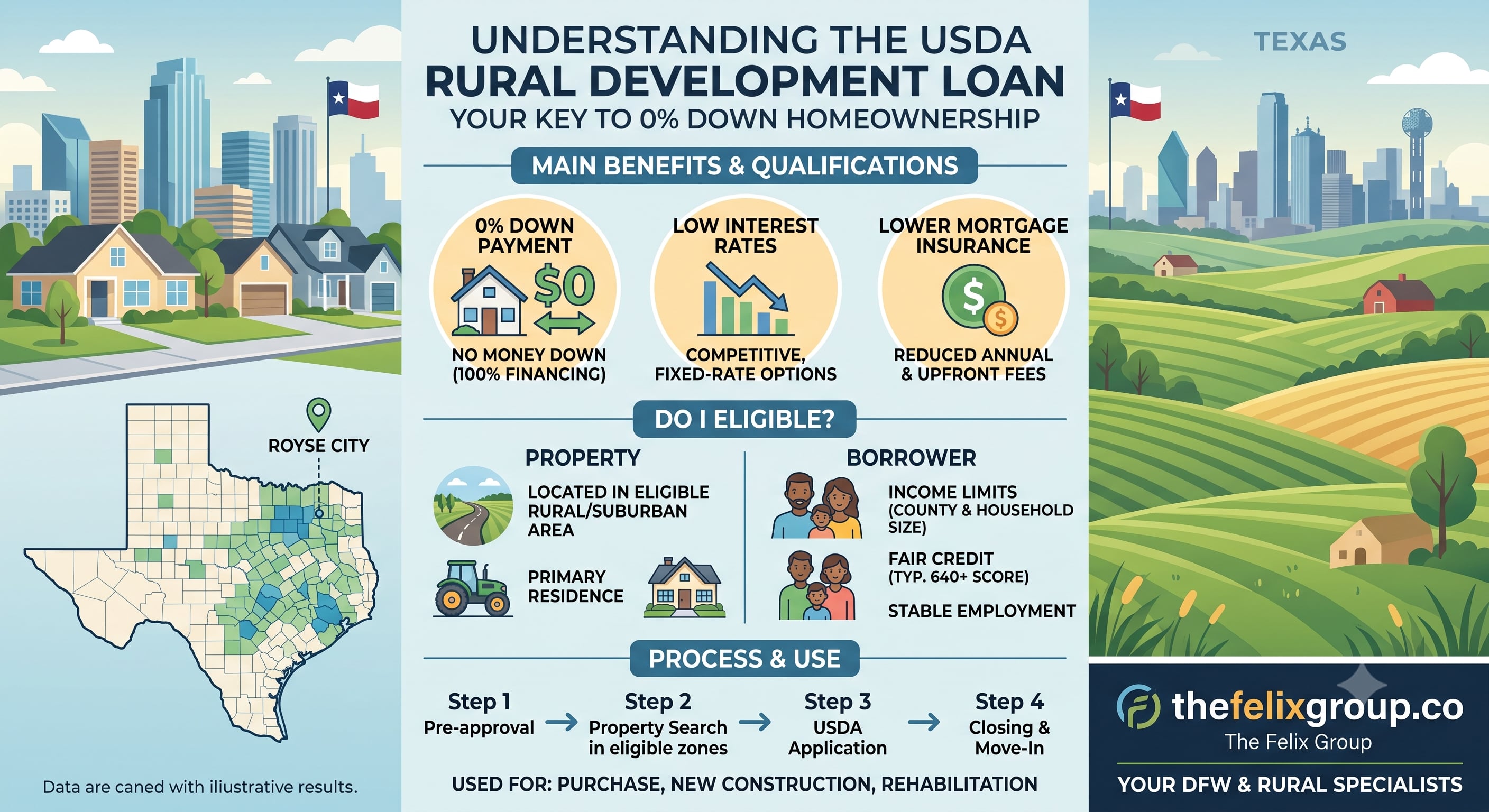
0% Down Payment: Finance 100% of the home’s purchase price—no down payment required.
Lower Interest Rates: USDA rates are often competitive with (or lower than) conventional mortgage rates.
Reduced Mortgage Insurance: Annual mortgage insurance fees are significantly lower than FHA or conventional PMI.
Flexible Credit Guidelines: Qualify with credit scores that might be tricky for traditional loans.
Who Qualifies for a USDA Loan?
To qualify for a USDA loan, both you and the property must meet specific requirements:
Income Limits: USDA loans are designed for moderate-income households. Household income limits depend on county size and household size (for example, standard household limits for 1–4 people hover around $110,000–$122,000+, depending on local market adjustments).
Primary Residence: The home must be your primary, single-family residence (no investment properties or second homes).
Location: The property must sit within a USDA-designated eligible zone.
Where Do USDA Loans Work in the DFW Metroplex?
While dense city centers like downtown Dallas, Fort Worth, or inner suburbs like Plano and Arlington are restricted, the DFW metroplex is massive. As North Texas continues to expand rapidly outward, many vibrant surrounding communities qualify for USDA financing.
Here is a breakdown of where USDA loans work across the Dallas-Fort Worth market:
1. East & Northeast of Dallas (Kaufman, Hunt & Outer Rockwall Counties)
Forney, Terrell, & Kaufman: Rapidly growing hubs with modern master-planned communities, family amenities, and quick commute access to Dallas via I-20 or Highway 80.
Royse City, Fate, & Caddo Mills: Outer pockets along the I-30 corridor feature USDA-eligible pockets where you can get brand-new construction or newer suburban homes with 0% down.
Greenville: A thriving community offering incredible value and full USDA eligibility.
2. South of Dallas (Ellis & Johnson Counties)
Waxahachie, Ennis, & Midlothian (Outer Boundaries): Historic downtown charm meets modern developments. Large portions of Ellis County qualify for USDA financing.
Cleburne & Alvarado: Great entry points for buyers looking for space, quiet neighborhoods, and easy access to Fort Worth.
3. West & Northwest of Fort Worth (Parker & Wise Counties)
Weatherford & Aledo (Outer Edges): Ideal for buyers who want proximity to Fort Worth with a countryside feel.
Decatur & Springtown: Rapidly expanding outer-ring suburbs with vibrant local cultures and fantastic USDA eligibility.
Is a USDA Loan Right for You?
If you are tired of renting, want to keep your liquid savings in your bank account, and are open to living in one of DFW’s fast-growing outer suburbs, a USDA loan could be the key to getting into your home faster.
Want to see if a specific house or neighborhood qualifies?
Reach out to our team today. We can map out USDA-eligible properties in your price range across North Texas and connect you with trusted local lenders who specialize in 0%-down financing.
Check out this article next